Affiliate disclosure
Retailer links appear only after the exact configuration, seller, price context, warranty, and availability have been checked. Any compensated relationship will be clearly disclosed.
What works
- Strong fit for the workload described in this review.
- Spec table and alternatives make the buying tradeoffs easier to compare.
- Affiliate CTA stays gated until product details are verified.
Watch-outs
- Exact price, stock, cooling, PSU, and warranty still need final verification.
- May not be the best value if a rival tower has stronger standard parts.
- Upgrade path depends on the exact motherboard, case, and power supply.
Linux readiness
Linux readiness pending driver, firmware, and vendor-support checks.
Power and cooling
Power, cooling, thermals, acoustics, and PSU headroom still need exact-configuration verification.
Before we recommend it
Verification Gates
Price and stock should be rechecked against the exact retailer SKU before any buy button is published.
- GPU VRAM
- System RAM
- NVMe storage capacity
- CUDA and software support
- Cooling under sustained load
- PSU headroom
- Local model fit
- Creator workload overlap
Overview
Choosing a prebuilt gaming PC for AI work is different from choosing one strictly for gaming. Local AI models, Ollama, GPU-heavy creative tools, and workstation-style productivity can place very different demands on a system.
A strong AI-ready gaming PC needs more than a powerful graphics card. Buyers should also pay close attention to GPU VRAM, system memory, storage capacity, cooling, power supply headroom, software compatibility, and long-term upgrade options.
This guide is designed for users who want a high-performance prebuilt desktop capable of handling local AI models, creator workloads, demanding productivity software, and modern gaming without building a system from scratch.
Quick Verdict
The best prebuilt gaming PCs for AI and local LLMs balance GPU performance, VRAM capacity, cooling, storage, system memory, and long-term reliability. These systems are often premium purchases, so the best choice depends on the full configuration, not just the graphics card listed on the product page.
For buyers considering a high-end prebuilt, the biggest question is not simply “How fast is it?” The better question is whether the system has the right hardware balance for local AI workloads, creative applications, gaming, and future expansion.
A great AI-ready prebuilt should have enough GPU memory for local model work, enough system RAM for multitasking, strong cooling for sustained loads, and a power supply that leaves room for long-term ownership.
Best For
This type of system is best suited for buyers who want a powerful desktop for more than traditional gaming.
Ideal buyers include:
Users running Ollama or other local AI tools
Creators working with GPU-accelerated software
Gamers who also want AI, video, rendering, or productivity performance
Buyers comparing premium gaming desktops and creator-ready systems
Users who want warranty support instead of building their own PC
Anyone who wants clear tradeoffs before spending high-end money
Skip If
A premium AI-ready prebuilt may not be the right choice for every buyer.
Consider a different option if:
A similar system with the same GPU is available for significantly less
The system has limited cooling for sustained GPU workloads
The power supply leaves little room for future upgrades
The case design restricts airflow or component access
The support and return policies do not match the price tier
The system does not include enough VRAM, RAM, or storage for your intended workload
What Matters Most for Local AI Workloads
When choosing a prebuilt gaming PC for AI and local LLM use, the GPU is usually the most important component, but it is not the only one that matters.
Key areas to compare include:
GPU model and VRAM capacity
System RAM amount and upgrade path
NVMe storage capacity and available expansion slots
CUDA and software compatibility
Cooling performance under sustained load
Power supply wattage and efficiency rating
Case airflow and fan configuration
Local model size compatibility
Creator workload performance
Warranty, return policy, and support quality
GPU and VRAM
For local AI workloads, VRAM is one of the most important specifications to understand. Larger local models can quickly exceed the memory available on lower-end graphics cards, even if the GPU itself is fast.
A faster GPU with too little VRAM may not always be the better choice for local AI. Buyers should consider both raw GPU performance and practical model fit. If the goal is to run larger local models, experiment with AI workflows, or keep the system useful for several years, VRAM should be a top priority.
For users focused on gaming first and AI second, a mid-to-high-end GPU may be enough. For users who want heavier local AI capability, larger VRAM configurations are often worth the extra cost.
System RAM
System RAM also plays an important role in AI-ready desktops. While GPU VRAM handles much of the heavy lifting for local models, system memory affects multitasking, data handling, creator workloads, browser usage, and general responsiveness.
For a modern AI-focused prebuilt, 32GB of RAM is a strong starting point. Users who plan to work with larger models, video editing, rendering, virtual machines, or heavy multitasking may benefit from 64GB or more.
The upgrade path matters as well. A system with accessible memory slots and standard desktop RAM gives buyers more flexibility later.
Storage
Local AI work can consume storage quickly. Model files, datasets, games, media projects, exports, and software libraries can take up a significant amount of space.
A 1TB NVMe SSD may be acceptable for a gaming-first system, but AI and creator-focused users should strongly consider 2TB or more. Extra M.2 slots or easy storage expansion are major advantages.
Fast NVMe storage also helps with loading large applications, managing project files, and keeping the system responsive during demanding workflows.
Performance Expectations
A well-configured AI-ready gaming PC should handle a mix of gaming, local AI experimentation, creative applications, and general workstation tasks. The strongest systems offer enough GPU memory to run larger local models, enough system RAM for multitasking, and enough storage for models, datasets, games, and project assets.
Buyers should look beyond short benchmark numbers. Sustained performance matters because AI processing, rendering, encoding, and productivity workloads can keep components under load longer than a typical gaming session.
The best prebuilts maintain strong performance without excessive heat, noise, or throttling.
Cooling and Noise
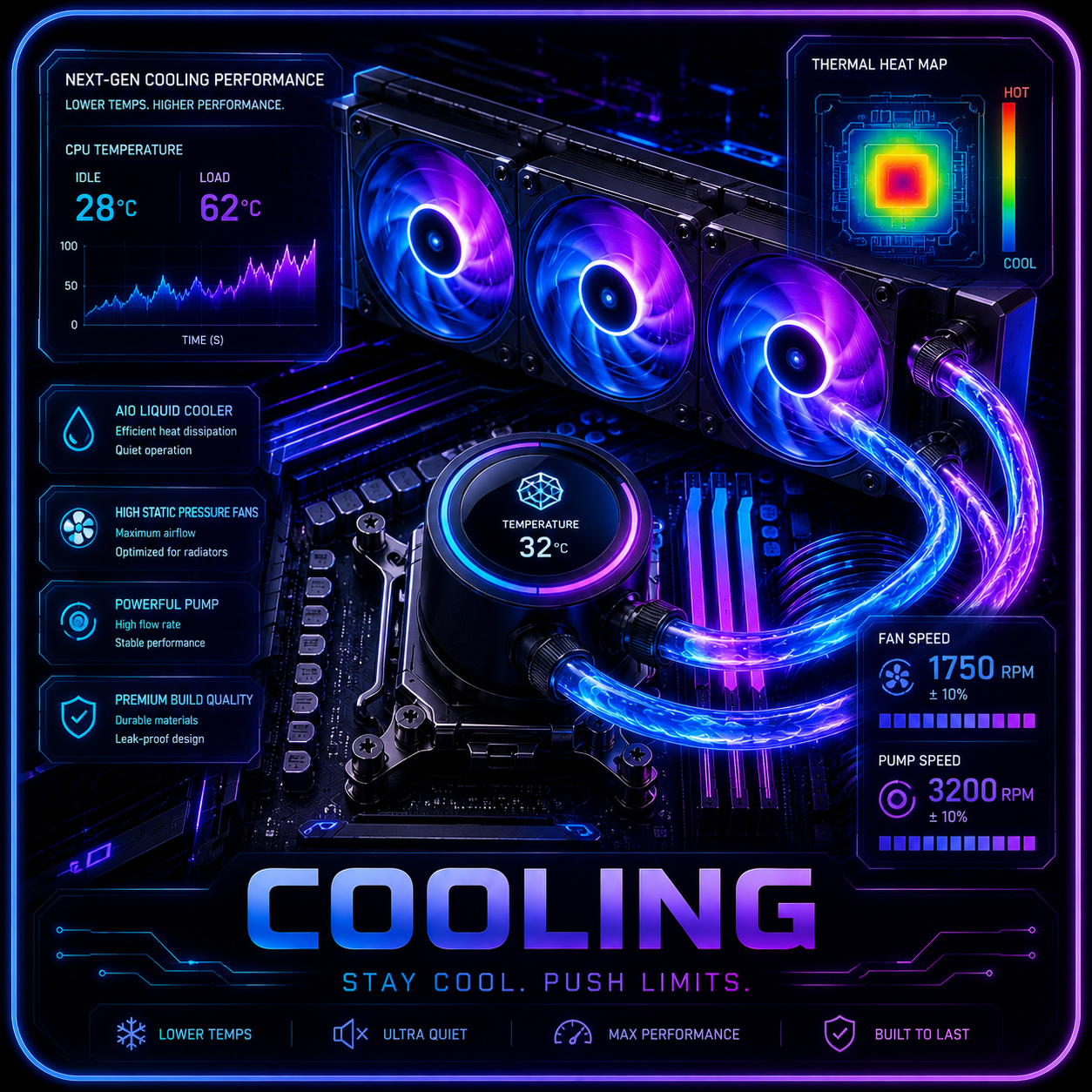
Cooling is especially important for systems used in AI and creator workloads. Unlike short gaming bursts, local AI processing, rendering, video encoding, and productivity tasks can keep the GPU and CPU under load for extended periods.
A strong prebuilt should maintain stable performance without excessive fan noise or thermal throttling. Case airflow, GPU cooler design, CPU cooling, fan curves, and internal cable management all affect the real-world experience.
Good cooling is not just about performance. It also helps with system stability, component lifespan, and day-to-day comfort.
Power Supply and Headroom
The power supply is one of the most overlooked parts of a prebuilt PC. For AI-ready and high-end gaming systems, PSU quality and wattage matter.
A good system should include enough power headroom for the CPU, GPU, storage, cooling, and future upgrades. An undersized or low-quality PSU can limit upgrade potential and may create long-term reliability concerns.
Buyers should look for systems with reputable power supplies, adequate wattage, and enough PCIe power support for the installed GPU.
Upgrade Potential
High-end prebuilts should offer a reasonable path for future upgrades. Buyers should look for standard desktop components, accessible memory slots, available M.2 storage slots, adequate PSU headroom, and enough physical space for future GPU or cooling changes.
Systems with proprietary parts, limited BIOS options, restricted cooling layouts, or undersized power supplies may be harder to upgrade later.
A good AI-ready prebuilt should feel like a platform, not a sealed box. The more standard and accessible the components are, the easier it is to extend the life of the system.
Software Experience
Software can make or break the experience of a prebuilt system. A clean Windows installation, stable drivers, useful control software, and minimal bloatware are all positives.
For local AI users, driver support and compatibility are especially important. NVIDIA GPUs remain popular for many AI workflows because of CUDA support, but buyers should still consider the full software stack they plan to use.
Users working with Ollama, Stable Diffusion tools, AI coding assistants, video editing applications, 3D rendering software, or GPU-accelerated creative tools should make sure the system matches their software needs.
Warranty and Support
Warranty terms matter more at this price level. A premium system should include clear support coverage, a reliable return path, and transparent seller information.
Important support factors include:
Warranty length
Who provides support
Return window
Seller reputation
Replacement part process
Whether upgrades affect coverage
Availability of documentation
For many buyers, one of the main reasons to choose a prebuilt system is support. A strong warranty and reliable support process can add real value, especially when buying a high-end configuration.
Gaming vs AI Workstation Use
A gaming PC and an AI workstation can share many of the same components, but they are not always optimized the same way.
Gaming performance often focuses on frame rates, resolution, GPU speed, and CPU balance. AI-focused performance leans more heavily on VRAM, sustained GPU load, memory capacity, storage, and software compatibility.
The best prebuilt gaming PCs for AI sit in the middle. They provide strong gaming performance while also offering enough hardware strength for local AI experimentation, creator workloads, and GPU-heavy productivity.
Final Thoughts
The best prebuilt gaming PCs for AI and local LLMs are not always the most expensive systems available. The right choice is the system that balances GPU power, VRAM, RAM, storage, cooling, warranty, and upgrade potential at a fair price.
For local AI users, the smartest purchase is usually the one with the best long-term hardware balance. A flashy case and a high-end GPU name are not enough. The system also needs proper cooling, enough memory, enough storage, reliable power delivery, and a support path that matches the investment.
A well-chosen AI-ready prebuilt can serve as a gaming machine, local AI lab, creative workstation, and productivity desktop all in one. That combination is what makes this category so appealing for users who want serious performance without building their own rig.
Related Reading
High-End Gaming PC Reviews
Local AI Rig Guides
AI Workstation Buying Guide
RTX 5090 Review
Best GPUs for Local AI
Gaming PC vs AI Workstation
Bottom line
Who Should Buy It?
Buyers who match the workload, budget, and upgrade assumptions in this guide.
Use this review as a buying map: compare fit, specifications, warranty, thermals, pricing context, and alternatives before choosing a retailer.
Update history
- 2026-06-16 - Product details and verification status reviewed.
Help improve this page
Found A Better Lead Or Real-World Detail?
Send a qualified product lead, correction, owner note, or review request. Strong submissions include exact model numbers, URLs, price context, workload, warranty notes, and what should be verified before publication.
Reader discussion
0 Comments
Add a correction, owner note, compatibility warning, or real-world buying context. Useful comments may help shape future updates, but private order details and account information should stay out of public discussion.